Since 2011, this has been our tradition of august. For a while the long night happened twice a year, and i noticed, but somehow it didnt last long, I guess it was due to money. Anyway now we have it regularly in August and thats also awesome cause its mostly still sunny and warm. The ticket this year came from a geocatching search, it was fun, it took me some trials to find it,eventough it seemed that the people that did find the tickets did not "understand what they found, mine where outside one of my favourite Berlin museum, the currywurst museum. ON the 29 of august, one day after my mom left =(, i came back to sleep before starting the day: we went first to the alte national gallery where the concert of Modest Mussorgskys (more on this later) there we said hi to Jasmin!. Then we started with the Bode Museum, with a guide for Eilige (fast revision).
Bode Museum
So the first disclosure here is, this museum does not deal with "bodenkunde"(soil studies) but from "Don Wilhelm von Bode", which anyway was only the one who carried on the project (since he could collect art pieces and he was a "von" person, i assume, he was loaded) cause the original idea was from Princess Victoria of Prussia, who published her ideas in a memorandum in 1883. This leads us to other interesting exhibition which deals with the women of Prussia, maybe she is one of them, (she died in 1929).
In the very short tour we had an expert explanation on selected art pieces, i always enjoy that very much, cause one can apreciate better a piece if an expert tells you were to look. After this tour we were free to wonder around, so we did at first a bit lost, till we reached the second floor were there was an awesome temporal exhibition called "Das Verschwundene museum" which translates into the "lost museum" at this point i need to complain, cause i loved the exhibition and its a topic I am totally interested in but the poster and advertising (that now i see everywhere) would have never catched my eye. I know probably i am not their target audience, and the lady that gave us the tour mentioned that the exhibition upstairs has received a lot of visitors.. STILL! i think they could have made a more catchy campaign.. one less "traditional".

The year 2015 marks the 70th anniversary of the end of the Second World War. Instigated by Germany, the war devastated vast stretches of Europe. Moreover, German units systematically looted the occupied territories and perpetrated the biggest art theft in the history of Europe. But for the Berlin museums, too, the commemoration of the end of the war in May 1945 is inextricably linked with the loss of sizable parts of their collections. In the final days of the war two fires at the Friedrichshain flak tower destroyed a great number of works of art, among them numerous celebrated masterpieces that had been stored there for safekeeping. Over the course of the rest of the year the Western Allies and the Soviet Union seized control of large parts of the Berlin collections. The bulk of these holdings was not returned to the then-divided city until the 1950s. Thefts committed by private individuals in the post-war turmoil account for further losses, though these are hard to quantify with any degree of accuracy. The losses of the war and immediate post-war period affect the collections of the Kaiser Friedrich-Museum, today's Bode-Museum, to this day. The Gemäldegalerie lost some 400 paintings and the Skulpturensammlung approximately one third of its holdings. Of the sculptures that were eventually returned, many were badly damaged. The exhibition The Lost Museum sheds light on the circumstances of the flak tower fires of 1945 and the subsequent fate of the works of art. Plaster casts and scale photographic reproductions aim to raise public awareness of the masterpieces of painting and sculpture lost by the Berlin collections. Moreover, the exhibition will address ethical and practical issues affecting the restoration of war-damaged works of art, a subject that continues to divide experts and that is also subject to the vagaries of the zeitgeist. The exhibition is conceived as a multi-voiced reflection: curators, restorers, archivists, historians, artists, and members of staff from the SMB's replica workshop accompany the visitor via an audio-visual guide that can be accessed in the gallery as well as online. What becomes apparent is that each generation deals with this legacy in a different way. The different approaches reflect not only individual or collective decisions to take a particular view of the past but also the political climate of the period. The exhibition is a cooperation between the Skulpturensammlung, the Museum für Byzantinische Kunst, the Gemäldegalerie, the Gipsformerei (replica workshop) and the Central Archive of the Staatliche Museen zu Berlin. It was developed with the support of the German-Russian Museum Dialogue initiative.Multimedia application for the exhibition "The Lost Museum" Article with photos
The most amazing thing for me what to hear some very famous artist names, which pieces are lost forever, for example, since they took the paintings out of their frames there is the case of one Boticelli (Virgin and the child with angels carrying candlesticks) which painting burned in a bunker but which frame survived in another bunker, thus one can see now the replica in black and white, inside the original frame, how sad. On the other hand it is relevant to realize the importance of the catalog archive, they had photos at least, thanks to those photos, now they know what they lost. In other famous losses there are two caravaggios and the whole Rubens collection... The other part that i liked a lot about this exhibition was the expert discussion/oppinion into when and how should the damage pieces we shown.
Schloss Schönhausen
This is yet another example of cross over stories, this is a castle, i say "castle" but is mostly a nice house, well this nice house was where for 60 years, Elisabeth Christine, the wife of Friderick the II lived. This was a sham marriage so she was basically relegated to this not very well located nice house, also apparently she had not enough money to furnish it. Anyway it seems that after her the house had no particular use till the DDR times, when i guess since they just took what ended in their territory, they used this house as the oficial residency for their first president (wilhem Pieck) they made one part of the house a guest house for important visitors, here is where it gets interesting, cause they had a very camp style, it was sixtis-rococo you can find golden and ruffles but still not cluttered or overdone, i guess this might be also due to the many changes of time, still id like to think that this is due to the minimalism of the socialistic style (austero). The already mentioned guest appartment has two room, one for ladies and one for gentlemen (!?). The guide mentioned important "böse" (evil or mean) people that sleep in this room, like Fidel Castro, Gadaffi and Yasser Arafat, i must admit i didnt register this at the right moment, but WTF! In the Ladies room (I never though the DDR could manage to infringe such a double moral police, moreover on their international guest!) they had a very flamboyant (and feministic) bathroom, the guide says this has become their signature piece. In this room people like Indira Ghandi, Raisa Gorvachova and the Queen Holland stayed, of course on this people there was no prejudice, women can not be "böse" right? ..
Embassy of Mongolia
This was a perfect match with the previous visit, both are very close to each other (in Pankow) As we approach the embassy we could here the music from Hosoo & Transmongolia, In the garden there were two games one could play, both were made of goat bones =) In the back of the garten there was a Jurta, we entered and there was a guy giving tips on what to see and how to travel to Mongolia, the experience of sitting inside a Jurta was supper cool, and over all i was happy, still i need to complain because i was expecting something "kulinarisches" meaning something cool and extraordinary to eat, and there was nothing, that was really disapointing =(
Jewish Museum
Somehow this museum is always in our long night, its difficult to avoid! thats because their offers are so awesome! furthermore when we got there and saw how many event they had to offer, we realize we could have been there earlier or longer (but ok ok thats not the idea of the long night) but i must mention that the oficial brochure (from the long night that is) wrote less than what they really offered (not like the Mongolian emabasy which offered more than what they really had) I would have loved to go to "Mazel tov! Heiraten auf Jüdisch" but ok we went to "Engel, Teufel, Schaf" which gave us the opportunity to enter their temporal exhibition. Its is called "Gehorsam" or obidience and deals with the binding of Isaac.This is the story where god asks Abraham to sacrifice his own son Isaac. The different interpretation in different religios currents are very interesting. But what caught my eye mostly was the aesthetics of the exhibition. The story is told in 15 different room, the rooms guide you through the story, but they are not just rooms are you are not "just entering" them, it is supposed to engage you and it works. My first mesmerizing feeling was in the third room (i guess,not sure of the number) where there are many different holly books open and in the background in a big screen caligraphy in latin arabic and hebrew is being writen in beautiful black ink. I find caligraphy has the ability to abstract you, to hipnotize you, more if you can not read but just "contemplate". The other very engaging room was the white room of angels, you where asked to take your shoes off, the floor was covered in a soft carpet and the walls were covered in feathers (somewhere i read that there were stains of blood, i did not see them)we were asked, do you believe in Angels? mmm this room was soft but if we have to talk about angels, i dont know what to think even not to mentioned... what are they? humas with .. wings? wings with feathers? wait now its even more creepy, and why do some look very young like the cherubines (always naked, of course) and others fully grown adults? ach. I dont believe in angels and this room gives me the chills, sorry (aa there is also a swan in the room, he has his feathers though, and the story contains no swans.. what is he/she/it doing here?)
Well the controversy comes in Satan's room (this room was number 6 i would have guessed though number 7 eventhough now that i care of seeing this from different believes, i bet 7 is not a bad number for everybody, like it is for the christians, did i say bad? i meant "full of meaning"). So Satans room is a dark room with a huge screen on one side and a bench to seat on the other, on the floor there are tiny round peebles. Satan is there trying to convince Abraham to persuade him to cast doubt on the divine arrangement. Dasha loved the choice of Satan, he is a white guy with long red hair, she liked him a lot but there is nothing spectacular or out of the norm with Satan. But then reading about the exhibition and trying to find the name of the satan actor,we found at least 2 depictions of Satan as travestie:

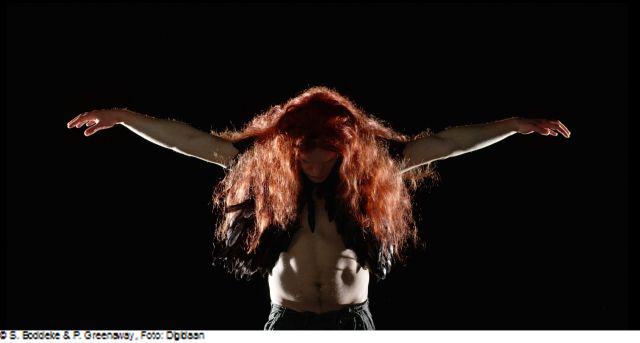
Jeder Protagonist dieses menschlichen Dramas erhält seinen eigenen Raum. Der verzweifelte Vater, die Mutter, die ihr Kind nicht schützen kann, aber auch Engel und Satan: Letzterer ein Transvestit mit langem roten Haar und schwarzer Federboa, der sich verzehrt vor Sorge um den kleinen Isaak. "Dein Vater will dich umbringen!" flüstert er dem Jungen zu. Der klatscht ihm spielerisch auf die Wangen. Der Boden ist bedeckt mit Kieselsteinen, rot angestrahlt wie Lava, schwer und geräuschvoll muss sich der Besucher seinen steinigen Weg bahnen.
Satan ist ein rothaariger Transvestit, er schneidet Grimassen und rezitiert seine Wut und wir versinken in Erinnerung. Erinnerung an Peter Greenaway und seine Filme, alles ist gut, kurze Erholung nur, Satan gibt uns den Hammel, für 5 Minuten!
What is this supposed to mean? why do they pick on Satan? Lets start with the i hope modern definition of travestit they took:
Travesti (literally "disguised")is a theatrical term referring to the portrayal of a character in an opera, play, or ballet by a performer of the opposite sex.
why is satan supposed to be performing the other sex?(my brain is about to implode, how would this be? i need to re-check my theory) I mean at this point it seems like the only solution is to ask Satan. It seems to me they are picking on Satans long hair and...? thats it. Well then, why not to pick on the Angel, lets presume angels are supposed to be male (AM not stating this i dont even know if it is so always but at least from the catholic bible is mostly the case) The angel is played by a woman, and she is wearing short hair and pants! is she not a travestit? (the whole calling is ridicoulus anyway, am just pointing out how all seems to be based on the lenght of Satans hair, or am i missing something else?)
side note appart, I loved how they brought the story close to us with all the abuse questioning (my reading i guess) why has a father power over his son, why would he follow this contructed entity over this touchable creature that he himself help created (if we believe man somehow help in the creation of babies) I found very relevant the connection they made with kids in war situation, who puts them in this situation, why are kids removed of their free will, why is it so that stupid-adults are allow to "care" for them? which god would encourage child sacrifices? Malalas words resound powerful in the last room of the exhibition
While the exhibition neither overtly criticises nor endorses the story or Abraham, at the end of the exhibition visitors are actively encouraged to reflect on issues of trust, power (abuse) and family. Having ‘been’ Isaac/Ishmael at the beginning of the exhibition, are they really an Abraham – someone with the power and readiness to put a fellow human being, perhaps even a child, through hell? “Why do we raise our children to be Abrahams?”, asked Boddeke at the press conference. Her question is reiterated in the archive footage from Malala Yousafzai’s Nobel Prize speech in the exhibition’s penultimate room. “The so-called world of adults may understand it, but we children don’t. Why is it that countries which we call ‘strong’ are so powerful in creating wars but so weak in bringing peace? Why is it that giving guns is so easy but giving books is so hard? Why is it that making tanks is so easy, but building schools is so difficult?– L. Garrett
Bröhan Museum
This is a museum very close to the Charlottenburg castle, we went there cause I wanted to see the Kimono temporal exhibition, it was a very good decision, the Kimonos were beautiful, and the exhibition consisted of only 3 rooms so we could see it all at the speed of the long night (which anyway was not too much what we did today). The kimonos are made of silk and dyed with natural colors.. the creations are contemporary made but the artists (and her daughter) follow the tradional way to make kimonos, anyway the colors and different dyes were very inspirational =) i liked it a lot!
Schloss Charlottenburg
yes yes, today was very royal, 2 castles! whats wrong!? anyhow i wanted to go to this guided tour 1.cause it was the latest you can find 2. i though they might shed some light on my favorite topic of this days...The Prussian women =P . I was right. I am struggling if i want to write about the fact that in the entrance the guard did not want to let us in cause the tour was "full" pff i was not about to turn around at 01:00 in the morning, after having cross Berlin to hear this guide specifically. Thanks to the time i guess the guard did not fight back when i told him how i noticed half the people bailed on the tour at the entrance. so we entered. The castle its quite nice, nothing to envy Sansouci (i though, but then, maybe I am still mad at the asembly line style audioguide they have in sansoucci! also at the price! thats definetly not worth it.. and they dont even let you explore! arg!) anyway, the rooms here are all repaired and there is still a lot to do, but as mentioned.. it is nice =)and gives one the castle impression that one expects when entering a "castle" contrasted to a nice house, i mean.
